
2025
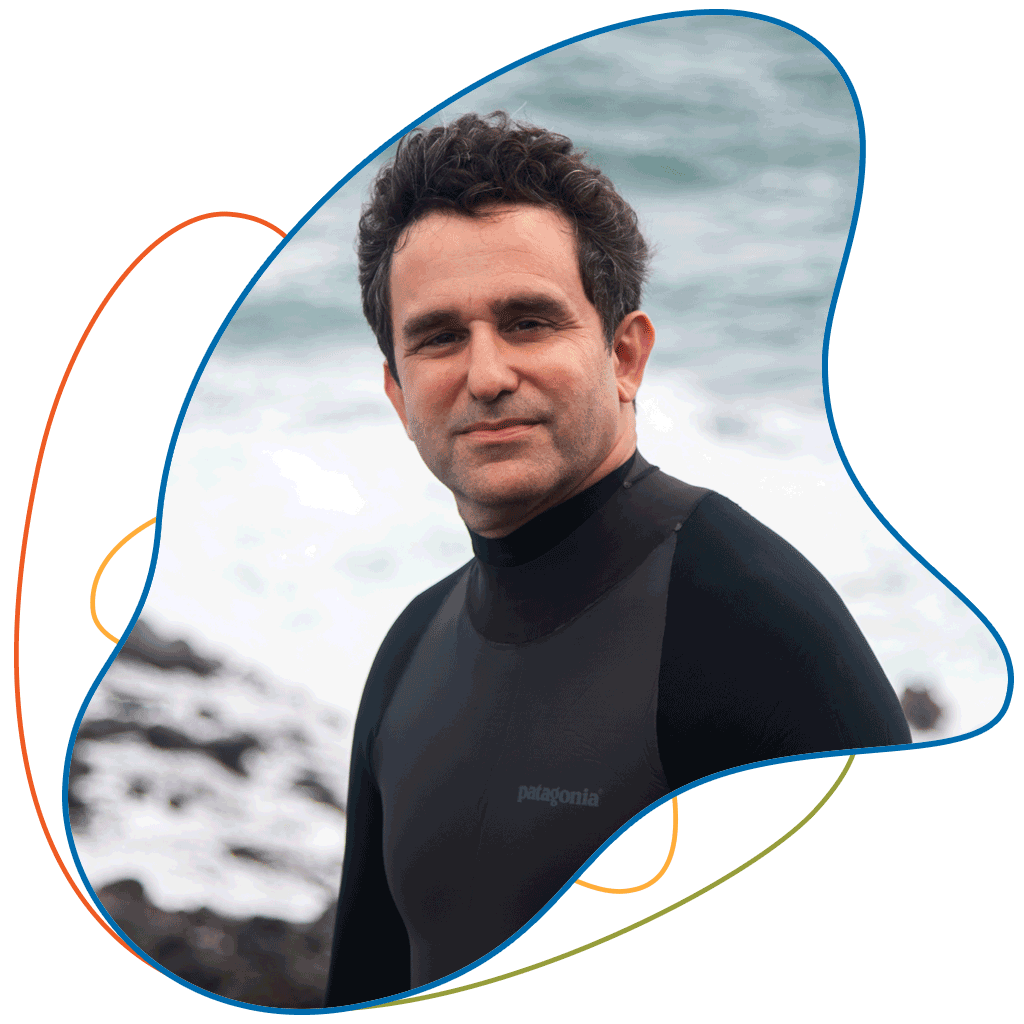
David Gruber
For bringing together science, technology, imagination, and empathy to decipher the language of whales, pointing towards new ways of understanding, interacting with and protecting non-human life.
Profile
David Gruber is the Founder & Lead of Project CETI (Cetacean Translation Initiative), a nonprofit organization as well as a National Geographic Society program that brings together over 50 scientists across eight disciplines to translate the communication of sperm whales. CETI has made pioneering scientific discoveries such as the elucidation of the sperm whale phonetic alphabet.
CETI’s vision is that these findings applied across species to exemplify how technology deepens human connection and motivation to protect the natural world. Gruber fostered the CETI – NYU School of Law’s “More Than Human Life” (MOTH) program collaboration. Together CETI and MOTH have published a futuristic legal article (What if We Understood What Animals Are Saying? The Legal Impact of AI-Assisted Studies of Animal Communication) that maps the potential impact for CETI’s findings on protections for whales and other lifeforms. CETI also conducts youth education and arts initiatives in Dominica, where its core research takes place, as well as global storytelling and arts initiatives.
Gruber is also Distinguished Professor of Biology and Environmental Sciences at the City University of New York and has been a National Geographic Explorer since 2014. His two decades of research before CETI, focused on climate, coral reef and deep ocean science. His laboratory invented technologies to perceive the underwater world from the perspective of marine animals, such as the “shark-eye-camera.” His research team discovered over 200 new species of biofluorescent fish and made the first observations of biofluorescence in sea turtles. And, through his long-standing collaboration with the Harvard Microrobotics Laboratory, Gruber has helped engineer some of the most gentle robotic systems ever created to study and interact with marine life.
Gruber also integrates science and art to expand public understanding of the natural world. He has collaborated with pioneering video and performance artist Joan Jonas for over a decade and co-curated the 2022 exhibition “Who Speaks for the Oceans?” at the Mishkin Gallery and the Tarble Arts Center. He holds a PhD in biological oceanography from the Rutgers Institute of Marine and Coastal Sciences and master’s degrees in coastal environmental management from Duke University and in journalism from Columbia University. From 2017-2018, David was a Fellow at the Radcliffe Institute for Advanced Study at Harvard University.
Marine biologist and explorer David Gruber has spent his career revealing hidden worlds beneath the ocean’s surface. From discovering new biofluorescent species to developing gentle technologies for studying sea life, his work has transformed our understanding of marine ecosystems—and of intelligence itself.
Through Project CETI (Cetacean Translation Initiative), Gruber leads an ambitious global effort to decipher the communication of sperm whales using advanced machine learning and non-invasive research methods. By combining biology, linguistics, robotics, and artificial intelligence, he and his team are working to translate the complex acoustic patterns of whale clicks into a form humans can understand.
The implications are profound. Project CETI is not only advancing science—it is reframing the ethics of how humans relate to other intelligent beings. Gruber envisions a world where curiosity replaces conquest, and where learning to “listen” becomes a scientific and moral imperative.
His leadership fuses rigor with imagination. Through innovation and collaboration, he is building bridges between disciplines, between species, and between ways of knowing. The work challenges us to consider that communication is not uniquely human, and that understanding may be the first step toward coexistence.
David Gruber’s pursuit of interspecies dialogue invites us to rethink what it means to be alive together on this planet—and to lead with humility in the face of the unknown.