
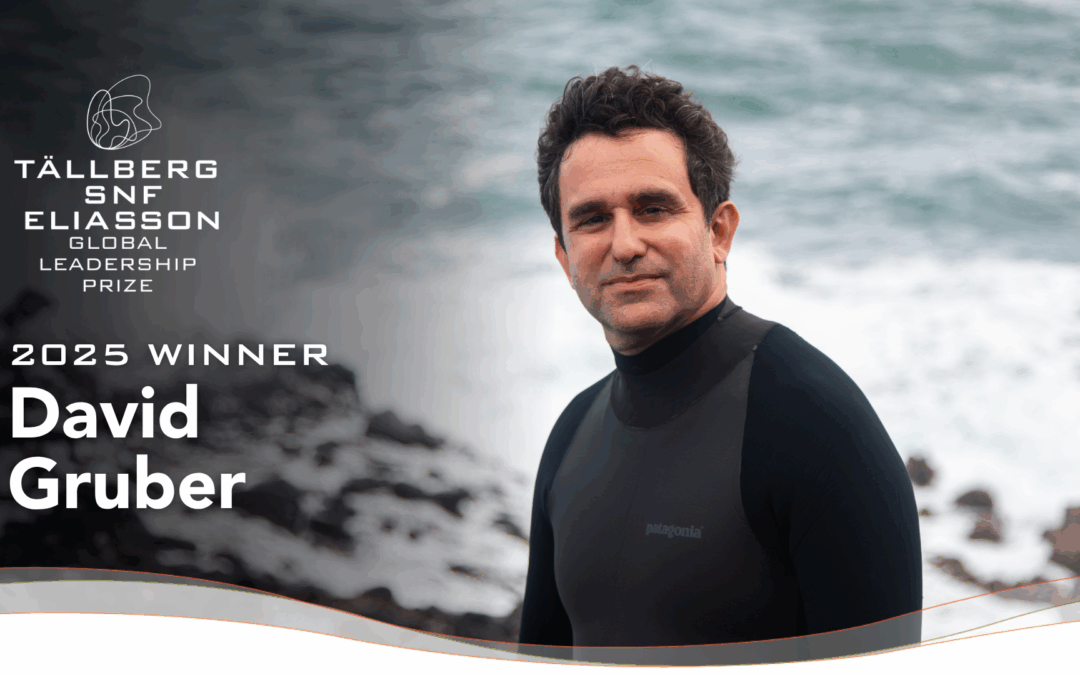
David Gruber has spent his life listening to the ocean. A marine biologist, explorer, and technologist, he began by studying the smallest forms of life—bacteria and plankton—and worked his way upward through the chain of marine existence: corals, sharks, turtles, and now whales. Each step brought him closer to a simple but radical question: What if we could understand another intelligent species?
As founder and president of Project CETI (Cetacean Translation Initiative), Gruber leads an ambitious, interdisciplinary effort to decode sperm whale communication using artificial intelligence, linguistics, robotics, and marine biology. His team’s goal is not to make whales talk to us, but to understand what they are already saying to each other.
For Gruber, this is more than science—it is an act of humility. “We are trying to listen without domination,” he says, “to learn what it means to share a planet with other intelligent beings.”
That philosophy underpins every aspect of Project CETI. Using non-invasive recording technologies and deep-learning algorithms, the team analyzes terabytes of whale clicks and codas recorded in the waters off Dominica. Their work has revealed remarkable complexity—vowel and dipthong features in sperm whale voices as well as regional dialects, rhythmic structures, and what Gruber and the CETI team calls a “sperm whale phonetic alphabet” of variations that may form the foundation of a whale language.
CETI is built around the same interdisciplinary curiosity that defines Gruber’s career. As he explains, “I’m a marine biologist and National Geographic Explorer, but my job is to bring together people who are far smarter than I am in their own fields—linguists, AI specialists, roboticists, philosophers—and let their insights converge underwater.”
That convergence is literal as well as conceptual. Working with engineers at Harvard’s Microrobotics Lab, Gruber has helped develop “soft, gentle robots”—machines capable of interacting with fragile marine life without harm. Inspired by jellyfish and clingfish, these “linguine-finger” robots can touch living creatures with one-tenth the pressure of an eyelid resting on an eyeball. The idea, he says, is to show that science can be “curious and kind at the same time.”
It is a principle that stands in quiet protest to the destructive legacies of exploration. In conversation, Gruber often cites his earlier fieldwork on coral reefs and the devastation he witnessed as warming seas turned once-living ecosystems into wastelands. “Whales are a way to reconnect,” he reflects. “They are vectors—connectors between humans and the ocean. The question is whether technology, which often separates us from nature, can instead bring us closer.”
That question animates not just Project CETI’s scientific agenda, but also its ethical one. Gruber and his collaborators at NYU School of Law’s “More Than Human Life” program are exploring how the recognition of non-human communication might reshape law and policy. “If one day we can translate whale communication accurately enough to know they are suffering from human noise or pollution,” he asks, “what responsibilities will that place on us?”
He is acutely aware that such possibilities cut both ways. Technology can reveal, but it can also exploit. Gruber speaks often of the need for “guardrails”—ethical principles to ensure that discovery serves compassion rather than control. “The question we must keep asking,” he says, “is not just ‘Can we do this?’ but ‘Does it benefit the whale?’”
In a world captivated by artificial intelligence, Gruber’s work offers a counter-narrative: AI not as domination, but as dialogue. Large language models trained on whale clicks instead of human words, robots that behave with empathy instead of aggression—these are not metaphors, but realities being built by his team. The project’s name itself, CETI, pays homage to SETI, the search for extraterrestrial intelligence. “We’re doing the same thing,” Gruber laughs, “but we’re looking inward—an intraterrestrial search for connection.”
Ultimately, Gruber’s leadership blends curiosity, collaboration, and conscience. His team is not trying to teach whales to speak, but to learn to listen. If successful, Project CETI could transform how humanity understands intelligence—not as a hierarchy, but as a shared spectrum of consciousness.
“In the 1970s,” he notes, “Roger Payne discovered that whales sing, and that discovery sparked the Save the Whales movement. Imagine what could happen if we learn to understand what they’re actually saying.”
For David Gruber, the ocean is no longer silent—it is speaking, and he believes the greatest act of leadership we can take is to listen.